
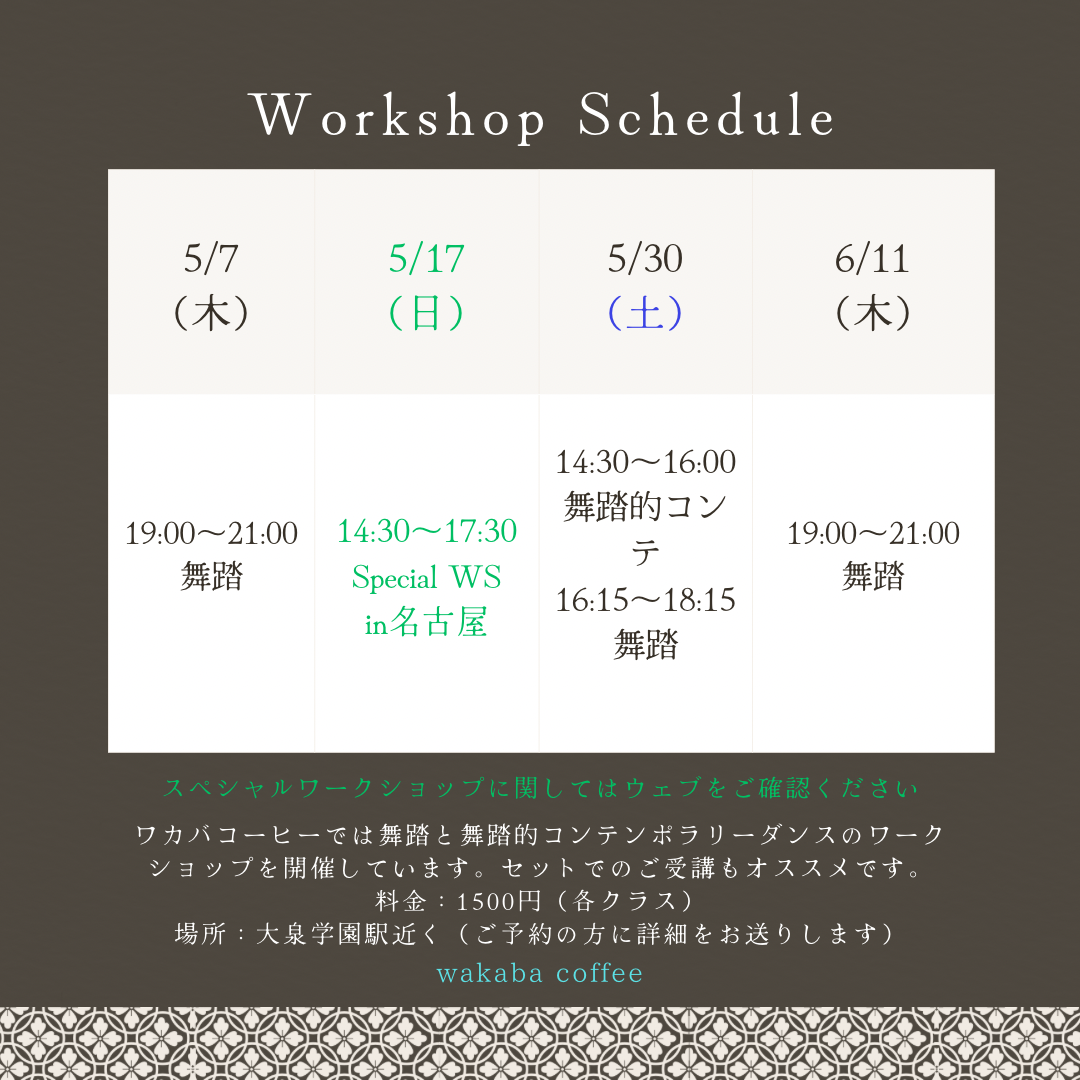
ワカバコーヒーが開催しているワークショップのスケジュールです。Scroll down for English Informantion. (English Available for all classes)
毎月開催している定期ワークショップは「舞踏」と「舞踏的コンテンポラリーダンス」の2つです。西武池袋線「大泉学園駅」の近くで行っています。定期ワークショップは1クラス2,000円で受けられます。
舞踏的コンテと舞踏の2クラスを同日に受講される場合は3,500円(500円割引)になります。
そのほかのイレギュラーなワークショップは、それぞれ受講料金が違いますので詳細をご確認ください。
| 日時 Dates | 内容 Contents | 場所 Location |
| 5月30日(土) 14時半〜16時 May 30th Sst. 2:30pm to 4:00pm | 定期ワークショップ「舞踏的コンテンポラリーダンス」 Regular Workshop “Butoh inspired Contemporary Dance” | 大泉学園駅近く Near Oizumi Gakuen Sta. |
| 5月30日(土) 16時15分〜18時15分 May 30th Sat. 4:15pm to 6:15pm | 定期ワークショップ「舞踏」 Regular Workshop “Butoh” | 大泉学園駅近く Near Oizumi Gakuen Sta. |
| 6月11(木) 19時〜21時 June 11th Thu. 7:00pm to 9:00pm | 定期ワークショップ「舞踏」 Regular Workshop “Butoh” | 大泉学園駅近く Near Oizumi Gakuen Sta. |
| 6月27日(土) 14時半〜16時 June 27th Sst. 2:30pm to 4:00pm | 定期ワークショップ「舞踏的コンテンポラリーダンス」 Regular Workshop “Butoh inspired Contemporary Dance” | 大泉学園駅近く Near Oizumi Gakuen Sta. |
| 6月27日(土) 16時15分〜18時15分 June 27th Sat. 4:15pm to 6:15pm | 定期ワークショップ「舞踏」 Regular Workshop “Butoh” | 大泉学園駅近く Near Oizumi Gakuen Sta. |
Above is Wakaba Coffee’s Butoh Workshop Schedule. We have Regular Workshops of“Butoh” and “Butoh Inspired Contemporary Dance”. They are held monthly near Ooizumigakuen station Seibu Ikebukuro Line. 2000 Yen per lesson.
Taking “Butoh Conte.”and “Butoh” on the same day will be 3500 Yen for 2 Lesson together.
The other irregular workshops are different prices. Please check the detail.
For questions email us!
研修プログラム Apprentice Program
より深くワカバコーヒー流舞踏に携わりたい方向けに、2026年より研修生プログラムを開始しました。詳しくはこちらをご確認ください。
For those who wish to engage more deeply with Wakaba Coffee’s approach to Butoh, we launched an apprentice program in 2026. Please see below for more details.
ワークショップ受講者の体験談
ワカバコーヒーでは海外からの受講者の舞踏を学びたいというリクエストにお応えして、舞踏の個人レッスンやクリエーションの見学、情報提供なども行なっています。体験者の感想の一部を載せております。
At Wakaba Coffee, in response to requests from international participants who wish to learn Butoh, we also offer private Butoh lessons, opportunities to observe the creative process, and various forms of guidance and information sharing. Below are some impressions and reflections from past participants.
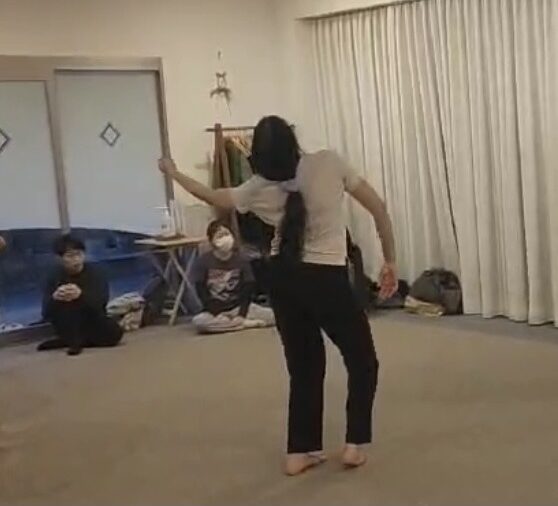
「私の名前はナタリア・イギータです。現在、Inter-University Center for Dance Berlin (HZT)の「Dance, Context and Choreography」学士課程に在籍しており、最終学期を迎えています。今学期は卒業制作に取り組んでおります。
私の作品において、学業以前から現在に至るまで繰り返し中心となっているテーマは「夢」です。ただし、それは物語的なイメージとしてではなく、“身体的状態”として夢を捉える試みです。これまでパフォーマンス、リサーチ・プレゼンテーション、ダンスワークショップなどを通して、さまざまな形でこのテーマに取り組んできました。
プロセスの出発点として、私は日本での自主研究期間を設けました。私はこの滞在を単なる海外経験としてではなく、卒業制作の始まりとして捉えていました。日本は、ホラー、幽霊文化、人ならざる存在との独特な関係性を持つ文化圏であり、私のリサーチテーマと深く関係していると感じたからです。
この期間における私の主な接点は、アーティスト運営のスペースであるワカバコーヒーでした。私はそこで舞踏クラス、ワークショップ、そして短期間のクリエイションに参加しました。私がこの場所を選んだ理由は、舞踏をコンテンポラリーダンスと密接に結びつけながら教えている唯一の場であり、なおかつ英語で参加可能な環境だったからです。コンテンポラリーダンスは私自身の専門分野でもあります。
この経験は、仏教寺院で初めてダンスワークショップに参加したという点でも特別な意味を持っていました。私たちは最初に寺院やそこに祀られている神についての説明を受け、そのことで実践がより広い精神的・文化的文脈の中に位置づけられていることを感じました。私にとってそれは、異なる知の形態が共存している感覚を生み出し、空間や存在への特有の意識を持って創作へ入ることを可能にしました。
ムーブメントの実践という観点では、私は提案された内容に比較的直接的に入り込むことができました。空間には安心感があり、指導も明確かつ的確でした。また、舞踏が単なる美学ではなく、「方法」として丁寧に説明されていた点を高く評価しています。同時に、コンテンポラリーダンスとの共通点にも驚きました。特に、コンポジションのツールや、イマジナリー・スコアを用いて動きを生み出していく手法には近さを感じました。
特に印象に残っているのは、「身体の外側にある何かに動かされる」という考え方です。それは、制御を失う感覚や、自分が何かに乗っ取られていく感覚という点で、私の悪夢への関心を強く呼び起こしました。また、恐怖だけでなく、「身体を器として捉える」という発想にもつながりました。この文脈では、技巧的な美しさは重視されていませんでした。むしろ重視されていたのは“本物の感覚”であり、その結果として生まれる動きは、抽象的で、歪み、グリッチしているようにも感じられました。それらは、私がホラーと強く結びつけている要素です。
(中略)
この経験は、身体的・概念的・文脈的な多くの刺激を私に与えてくれました。今後はそれらを自身の実践の中で翻訳していきたいと考えています。
— ナタリア・イギータ(舞踊大学学生)
My name is Natalia Higuita. I am currently a BA student in Dance, Context and Choreography at HZT, now in my final term. This semester is dedicated to the development of our Bachelor Assessment, framed as an artistic research process in which we apply project-related working methods and develop an appropriate artistic format.
Before and throughout my studies, a central recurring topic in my work has been dreams, approached as bodily states rather than narrative images. I have engaged with this topic in different ways through performances, research presentations, and dance workshops. For my Bachelor Assessment, I chose to focus more specifically on nightmares, horror, and liminal states, as spaces where the body shifts, loses control, or becomes something unfamiliar.
As a starting point for this process, I organized a self-study period abroad in Japan. I understood this period not as a separate experience, but as the beginning of my degree project. Japan felt particularly relevant in relation to my research, due to its distinct cultural relationship to horror, ghost lore, and non-human entities. What interests me is how horror can operate through atmosphere, silence, transformation, and subtle unease qualities that I relate to dreams and that I wanted to explore further through embodied practice.
My main point of connection during this period was Wakaba Coffee, an artist-run venue where I participated in Butoh classes, workshops, and a short creation process. I chose this place because it was the only context I found where Butoh was taught in close connection with contemporary dance, which is my field of work, and where classes were accessible in English.
This experience was particularly meaningful as it was my first time attending a dance workshop in a Buddhist temple. We were welcomed into the space with an introduction to the temple and its god, which situated the practice within a broader spiritual and cultural context. For me, this created a sense of coexistence between different forms of knowledge and allowed me to enter the work with a specific awareness of space and presence.
In terms of movement practice, I found myself able to engage quite directly with the proposals. The space felt safe, and the guidance was clear and precise. I appreciated that there was a detailed explanation of Butoh, not only as an aesthetic but as a way of working. I was also surprised to recognize similarities with contemporary dance, particularly in the use of compositional tools and imaginary scores to generate movement material.
One aspect that stayed with me was the idea of being moved by something external, a force outside the body. This brought me back to my interest in nightmares, especially in relation to the absence of control and the sensation of being overtaken. I connected this to fear, but also to the idea of the body as a vessel. In this context, virtuosic aesthetics were not prioritized. Instead, the focus was on real sensation, which often resulted in movement that felt abstract, distorted, or glitching qualities I strongly associate with horror.
. . .
Overall, this self-study period has functioned as a starting point for my degree project. It has provided me with physical, conceptual, and contextual inputs that I now need to process. Moving forward, I am interested in translating these experiences into my practice, continuing to work with nightmares as embodied states, and exploring how elements such as distortion, loss of control, and transformation can be developed within a choreographic framework.
— Natalia Higuita